
> Cuisine > Music&Dance >Crafts >Architecture >Calligraphie and Arts
Women's clothing varies greatly from region to region in terms of colour, material and style.Most women in Oman wear trousers, the sirwal. Wide and comfortable at the top, they are tight at the ankles. They are richly decorated with embroidery and a zip fastener makes it easy to get out. On top of this, she wears a shirt that reaches down to her knees, the kandoura. It is also decorated and matches the colour of the trousers. In the Dhofar region, this "shirt", which is made of heavy velvet, reaches down to the ankles and even drags on the floor at the back.
With the headscarf, the lahaf, the variations - be it size, colour or pattern - are almost limitless. The abaya, the black cloak, is worn by many women in Oman in the city over colourful dresses, but the face is not covered.
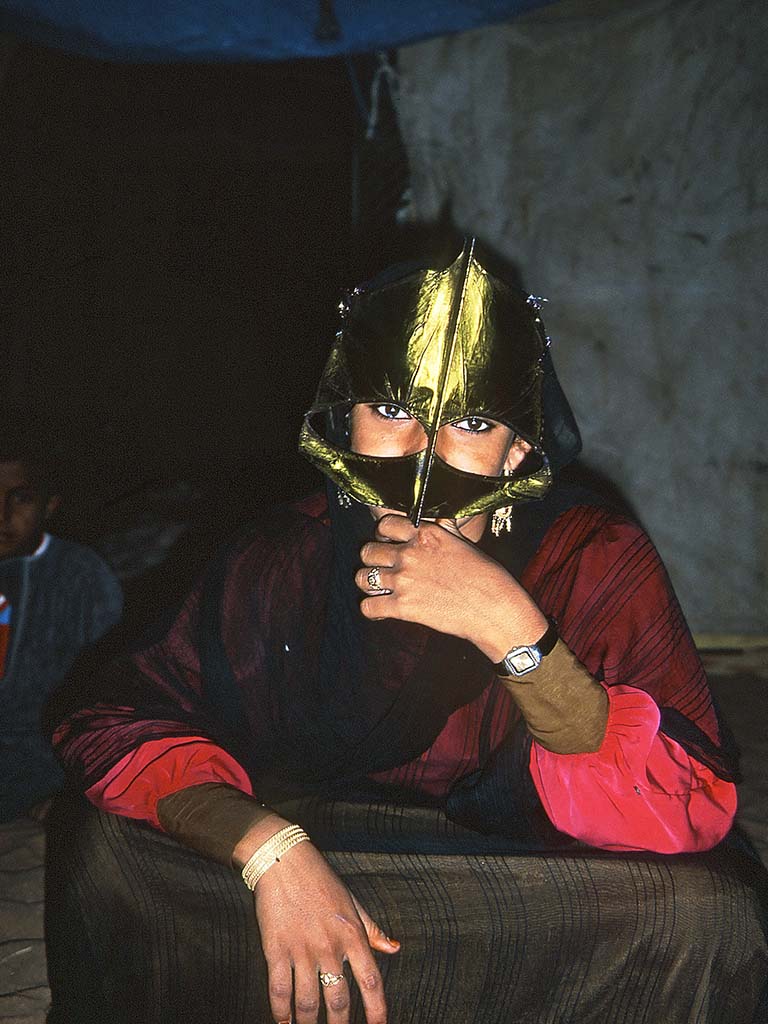
Bedouins and some women on the coast and in towns wear a mask, the burqa.
The burqa was and still is worn by Bedouin women in the desert to protect them from the sun and sand. Contrary to many prejudices, Omani Bedouin women like to wear it.
"We wear the burqa not because it is shameful to show ourselves without it, but because it is nice to show ourselves with it.
This quote from an Omani woman makes it clear that a judgement about the burqa quickly ends up in a traditional prejudice.
The mask has its origins in the women of the desert, who wear it to protect themselves from the sun and sand. They also wear these masks. The burqas are usually black, but occasionally they glow gold or purple. There are big differences in the design. Some masks emphasise the woman's gaze with their cut-outs, while others barely cover the face, framing it at most.
► Here you will find, among other things, tips for the "correct" clothing of tourists in Oman
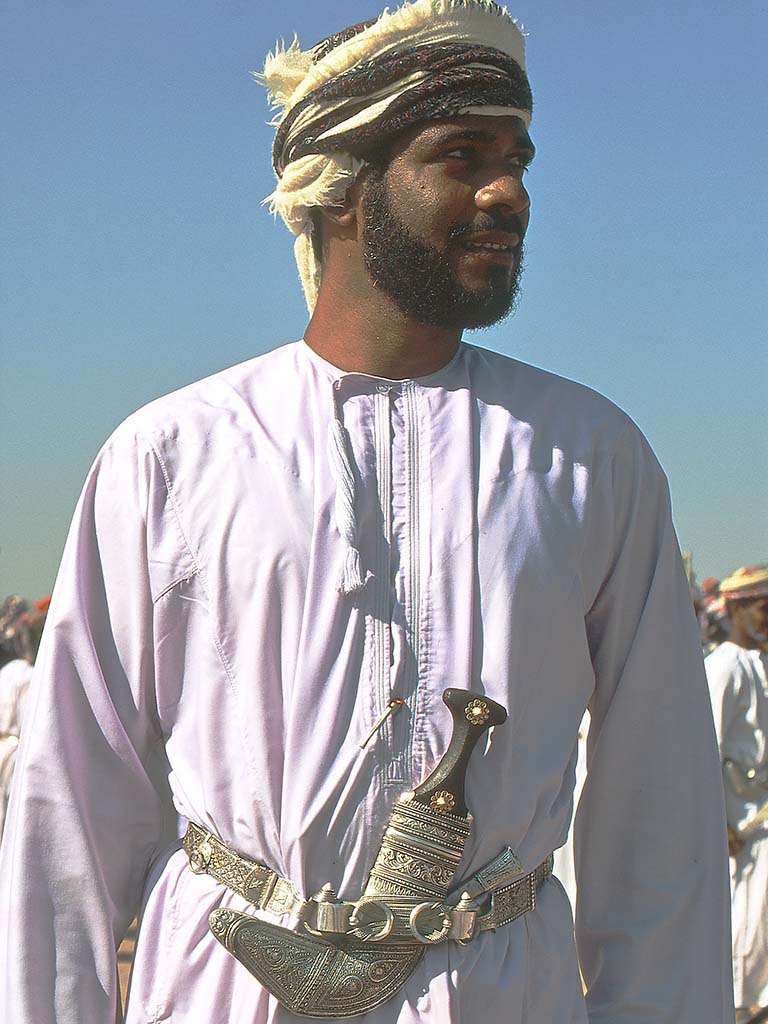
Headgear is an important part of men's clothing in Oman. They wear a round cap or a cashmere scarf.
Many Omanis wear a curved dagger over their long robes.
No man in Oman leaves the house without a headdress. It consists of either a round cap, called a kumma, a cashmere scarf, the massar, or a combination of both, whereby the massar is wrapped over the kumma.
The long robe is called dishdasha and has three main features: It has no breast pocket, a tassel dangles from the collar, which is dipped in perfume, and thirdly, it doesn't just come in white, as in the Emirates or Saudi Arabia, but in every colour imaginable. Underneath, by the way, the man wears a wrap, the wizaar, which corresponds to a pair of pants.
Many Omanis don their curved dagger, the khanjar, not only for festive occasions. However, a black or brown cloak-like bisht, which is decorated with a gold border on the front, is reserved for official events only.



Your contacts for travelling with Arabia Felix:
Maria Popp and Karin Nowack
Phone: +49 (0)89 / 30 77 92 00
info@oman.de
ARABIA FELIX Synform GmbH
Treffauerstraße 18
81373 München
Germany
Tel: +49 89/30779200
E-Mail: info@oman.de
VAT-ID: DE201885274