
Camels are certainly the most common animals in Oman, alongside goats. They can be seen not only in the country's sandy deserts, but also in the gravel plains and even in the mountains of southern Oman. They appear to roam freely through the landscape, but they all have owners who check on them regularly and feed them when necessary. They vary in color from light sand beige to black and provide the Bedouins with not only milk but also meat. However, camel meat is only served in a few Omani restaurants.
Camels approaching the road pose a danger to drivers because, as the largest animals in the region, they are used to everyone giving way to them – including drivers. If a camel approaches the road or moves along the roadside, you must always expect it to spontaneously enter or cross the roadway. In such cases, it is therefore better to brake hard or stop until the situation is clarified.
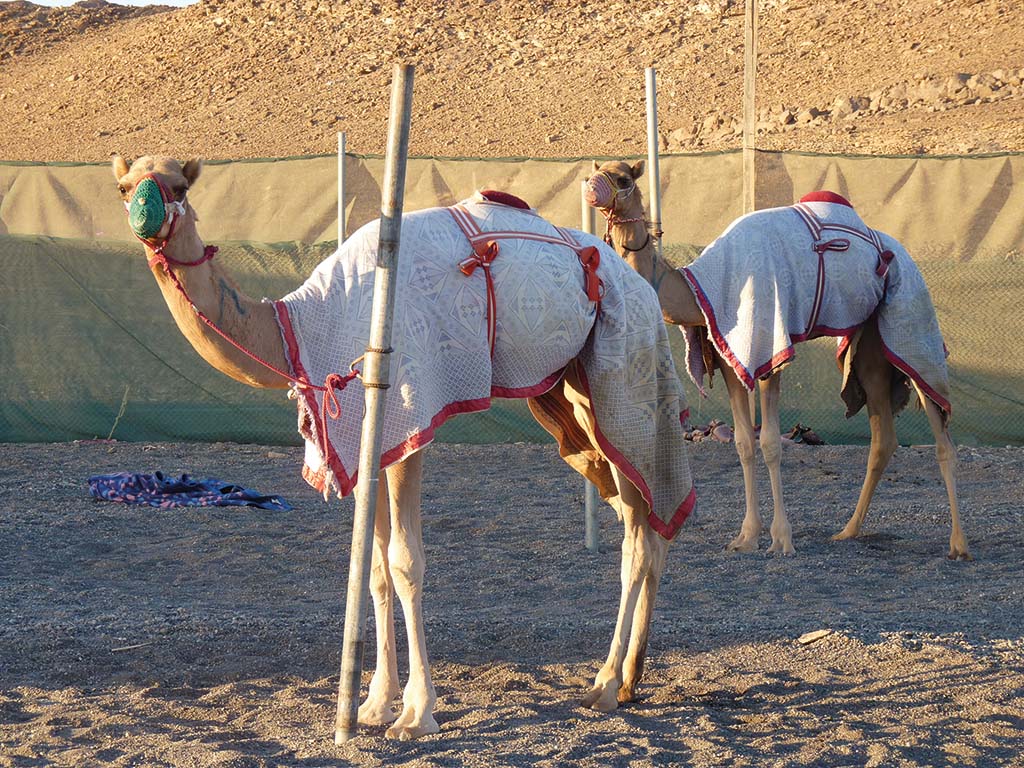
The Bedouins know the value of their racing camels, and the price is accordingly: the best ones change hands for over 500,000 Omani rials (about 2,3 million euro). They are preferably bought by the rulers of the neighbouring United Arab Emirates.
In Oman, camel races usually take place on National Day and the Id festivals at a special racecourse in Nizwa, but only rarely during the rest of the year and then usually in places that are difficult for visitors to access, far away from any tarred roads. Camel racing is not a tourist spectacle in Oman, but the great passion of the Bedouins - and it was also the passion of Sultan Qaboos.



Your contacts for travelling with Arabia Felix:
Maria Popp and Karin Nowack
Phone: +49 (0)89 / 30 77 92 00
info@oman.de
ARABIA FELIX Synform GmbH
Treffauerstraße 18
81373 München
Germany
Tel: +49 89/30779200
E-Mail: info@oman.de
VAT-ID: DE201885274